
— INFO@SCALECOMM.NET— CAIRO · RIYADH · DUBAI
● In App Store review Shopify App 8 Arabic dialects
— FASEL · فاصل / The souk, engineered

Let them haggle.
You still win.

Fasel is the Shopify app that puts an AI souk merchant on your storefront. Customers negotiate the price — in their own dialect, the way they've bargained their whole lives — while a deterministic engine works every deal down to a number that's always above the floor price you set. The customer feels like they won. Your margin knows you did.

8Arabic dialect packs · 38 lines each
100%Deterministic — no LLM improvising your prices
1-useShopify discount codes, minted per deal
0Theme code changes — app embed, toggle on
— WATCH / The souk merchant at work

Fixed prices are a Western import.
Your customers never signed up.

Walk any souk from Cairo to Riyadh and you'll watch the oldest conversion funnel on Earth: a buyer who wants the thing, a seller who wants the sale, and a short negotiation that ends with both sides feeling clever. E-commerce deleted that conversation and replaced it with a static price tag and a back button.

The result shows up in your analytics as abandonment. The customer who would have happily paid 8% under list — and told their friends about the deal they cut — instead bounces to a competitor, or waits for a sitewide sale that costs you 25% across the entire catalog.

Discount codes don't fix this. Codes are broadcast margin erosion: everyone gets the same cut whether they needed convincing or not. What the souk always understood is that discounting is a negotiation, not a policy — the discount should be exactly as deep as this one customer needs, and not a piaster deeper.

That's Fasel. فاصل — the one who haggles. It sits quietly on your product and cart pages, watches for the moment a customer starts to leave, and opens the one conversation MENA shoppers have been having for a thousand years.
70%+of carts are abandoned worldwide — 7 of every 10 shoppers who added an item never pay. Across MENA the rate runs above the global average.
$260Bin lost orders is recoverable in the US & EU alone. Abandonment is the single biggest leak in e-commerce.
40%of cart abandoners switch to a competitor instead of returning to the original store.
32%have abandoned a cart because they found a discount at a different retailer.

— Sources: Baymard Institute (meta-analysis of 50 studies) · DontPayFull · RetailMeNot

Purchases are now discount-driven.

87%say a discount is the single strongest motivator not to abandon a cart — above every other incentive.
70%can be influenced by a discount into an impulse purchase.
62%of clothing shoppers deliberately delay buying until a discount appears.
60%say a coupon speeds up their purchase decision.

The discount is no longer a promotion tactic — it's the purchase trigger.

— Sources: Capital One Shopping Research · Valassis

— THE KEY INSIGHT /

The one thing e-commerce deleted: negotiation.

For all its choice, online shopping made the customer powerless on the one variable that matters most: the price is displayed, and the customer must accept it.

MENA is a bargaining culture — shoppers compare aggressively and expect to negotiate. The souk trained the customer; the website silenced them.

What if the customer could talk back to the price?

The highest-intent customer
you'll ever lose.

The add-to-cart-then-exit shopper is the highest form of potential customer: intent is proven, the product is chosen — only the price equation failed. Today's tools chase this customer after they've already left — into a crowded inbox and a feed full of competitors.

The cheapest, highest-converting moment to act is the second before they leave — and almost nobody acts there. 48% of abandoners cite unexpected extra costs, and exit-intent popups are the highest-converting popup type of all, at 17.12%.

— Today · per 1,000 visitors

  1. 1,000 visit the store
  2. ~100 add to cart
  3. The price is final — take it or leave it
  4. 19 pay at checkout

Email recovery wins back 3–5%. Paid retargeting recovers up to 26% — paying twice for the same customer. 40% of the rest land at a competitor. Most abandoned carts are never recovered, by anyone.

— With Fasel · per 1,000 visitors

  1. Exit intent detected — Fasel intercepts the leavers
  2. The merchant banters and counters over 4–6 rounds
  3. The deal closes at a price you control — floor server-enforced
  4. ~29 pay at checkout — single-use code, straight to native checkout

+52% more completed orders — before email and retargeting even run.

— Benchmarks: cart-abandonment popups convert 17.12% on average · exit interventions recover 10–15% of abandoning visitors · gamified variants trend higher (Baymard · OptiMonk · Conversion Sciences)

How a deal happens.

01 — TRIGGERA customer hesitates: exit-intent on desktop, inactivity on mobile. Fasel opens — in the dialect you picked for your market, from Egyptian to Gulf to Levantine.
02 — HAGGLEThe customer taps quick replies or names their price. The concession engine responds with scripted, personality-rich lines — every counter-offer computed, never improvised.
03 — FLOORYour floor price lives server-side. However the conversation goes, no path through the engine can land below it. The browser never even sees the number.
04 — CLOSEDeal struck → Fasel mints a single-use Shopify discount code for exactly the agreed price, applies it, and walks the customer to checkout. Code can't be shared, screenshot, or reused.
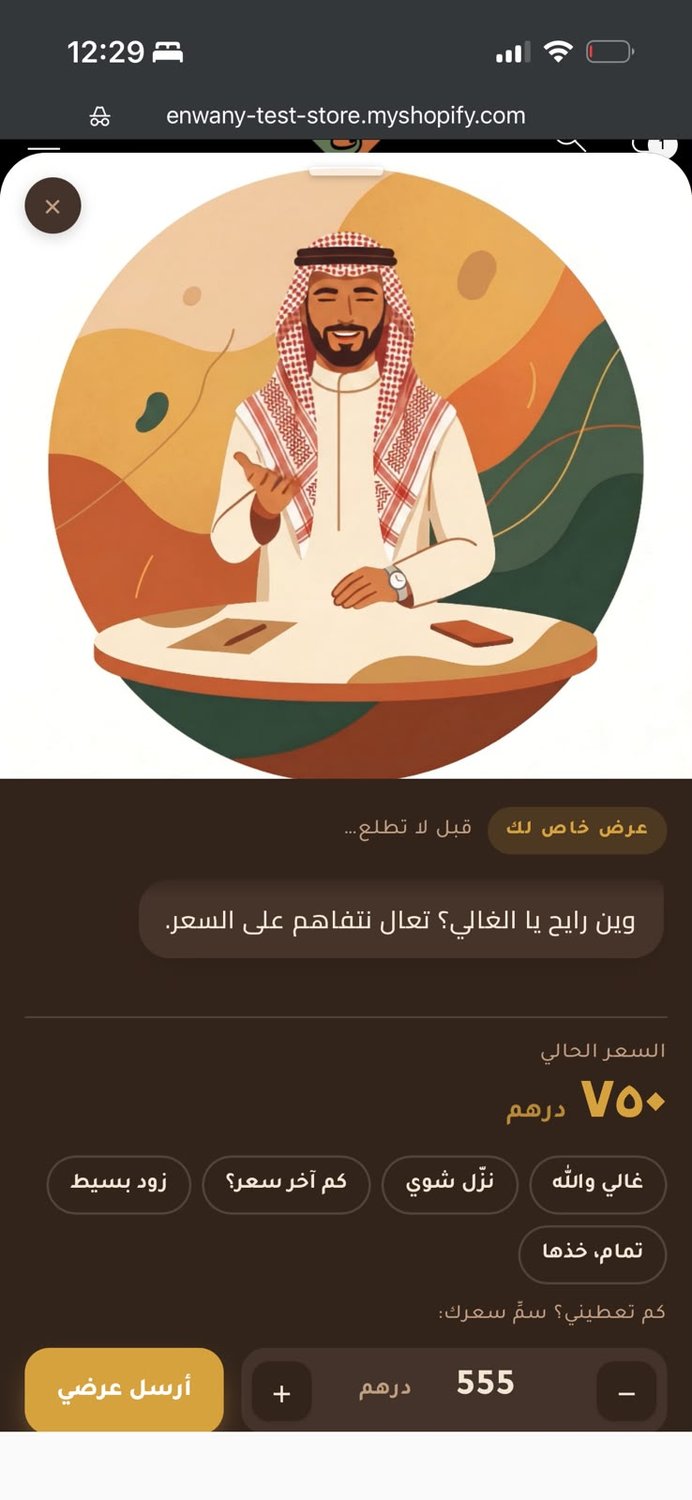
Fasel negotiation widget on a mobile Shopify store — the souk merchant counters at 750 dirhams with quick-reply haggling chips in Gulf Arabic
— Fasel live on a test storefront · Gulf dialect pack

Built like a storefront feature,
not a popup.

Fasel ships as a Shopify theme app extension — an app embed the merchant toggles on. No theme edits, no code pasted into Liquid, nothing to undo at uninstall. The widget inherits the storefront's direction handling, renders fully RTL, and stays out of the way until the moment it can save a sale.

The personality is the product: quick-reply chips like «غالي والله» and «نزّل شوي» make the customer's side of the haggle one tap. Every dialect pack is 38 hand-written lines — openers, counters, holds, and closers — tuned to sound like the merchant your customer grew up buying from.

  • ✓ Egyptian · Saudi · Gulf · Levantine · Iraqi · Moroccan · Sudanese · MSA
  • ✓ Product- and collection-level enablement
  • ✓ Deal analytics: sessions, close rate, average concession
  • ✓ English UI available for mixed-market stores

Why haggling converts.
The science.

— WHY 01 / Gamified engagement

Play beats popups, 2.3× over.

Gamified popups convert at 8.67% against 3.70% for classic static ones — a 2.3× lift just from adding play to the offer. Fasel goes beyond spin-to-win: the shopper isn't spinning a wheel, they're negotiating — the most engaging game there is.

+40% engagement lift from gamified mechanics · 28.98% offer conversion among engaged visitors vs ~4% baseline

— WHY 02 / The earned price

A haggled price feels like a win, not a coupon.

The shopper invested effort, went rounds, and earned that number. Effort-justification and variable-reward mechanics make an earned discount more valued than an identical handed-out one. Every other customer got the listed price — this customer beat it. That feeling converts, and builds the story they tell their friends.

— WHY 03 / Urgency at the close

The countdown starts when the deal closes.

The moment a haggle ends, a countdown starts on the reserved price: take it now or lose it. Countdown timers lift conversion 8–14%; loss-framed urgency converts 15–20% higher than gain-framed messaging; time-based urgency nearly doubles high-involvement purchases across 131 studies. And Fasel's urgency is authentic — the code genuinely expires, single-use. No dark patterns.

Authentic timers outperform fake ones 2–3× long-term

— Sources: OptiMonk · Gartner · Wisepops/Alia · Growth Suite research review · Journal of Retailing meta-analysis

— 01 / Core Industry-first

A deterministic concession engine.

Fasel doesn't hand your pricing to a language model and hope. Every counter-offer comes from a scripted state machine: concession curve, hold thresholds, walk-away lines. Same inputs, same outputs, auditable. The Arabic is pre-written by humans — the math is done by the engine.

— 02

Server-side floor price.

The floor lives in the app's backend, never in the browser. No devtools trick, no request tampering, no prompt injection can close a deal below it — the discount code simply cannot be minted for less.

— 03

8 Arabic dialect packs.

38 lines each, written for character: the theatrical Egyptian merchant, the dry Gulf closer, the warm Levantine uncle. Pick the pack that matches your market — or run MSA for pan-Arab reach. Merchant persona, popup theme, brand colors, and script lines are all yours to control — custom brand avatars ship in two business days.

— 04

Exit-intent + inactivity triggers.

Fasel opens when the sale is already leaving: cursor heading for the tab bar on desktop, scroll gone quiet on mobile. It rescues revenue you'd otherwise report as bounce — it doesn't tax customers who were buying anyway.

— 05

Single-use Shopify discount codes.

Every closed deal mints a native Shopify discount scoped to the negotiated amount, one use, short expiry. Deals can't leak to coupon sites, can't be shared in group chats, can't be stacked.

— 06

Zero theme surgery.

Theme app extension, app embed toggle. Install from the App Store, flip it on, set your floor, pick your dialect. Uninstall leaves no orphaned code behind — Shopify removes the embed cleanly.

— 07

Per-product control.

Enable haggling only where it makes sense: slow movers, high-margin lines, seasonal stock. Keep your hero products at fixed price while Fasel clears the long tail.

— 08

Deal analytics.

Sessions opened, deals closed, average concession, revenue recovered. See exactly what the souk merchant earned you this month — and what discount depth actually closes your customers.

— 09 / Stack

The same rails as Enwany.

Remix, Prisma, PostgreSQL on Railway, Shopify GraphQL Admin API — the production stack already running our first app. Built by the same team, operated with the same discipline.

Pricing.

Start free, prove the close rate on your own traffic, then scale up as negotiated deals become a channel. Every tier includes the full engine — tiers scale by deal volume, dialects, and control.

— Free

$0 / month

  • Full concession engine
  • Starter deal volume to test
  • 1 dialect pack
  • Exit-intent + inactivity triggers
  • Single-use discount codes
— Starter

$15 / month

  • Higher monthly deal volume
  • All 8 dialect packs
  • Per-product enablement
  • Deal analytics
— Pro

$100 / month

  • Everything in Growth
  • Highest deal volume
  • Advanced analytics
  • Early access to new dialects & features

— Currency: USD · Billed through Shopify · Final tier limits published at App Store launch.

Work Services — Shopify Apps Enwany Fasel About Contact Get early access
— Language EN AR
— INFO@SCALECOMM.NET